Legal Description
CON 4 PT LOT 9
General Description of Property
4005 County Road 11 is located in an agricultural area on the Northwest corner of County Road 11 and 4th Concession Road, just North of the Settlement Area of Harrow on a 1.5 Hectare lot.
Description of Property that has Cultural Heritage Value or Interest
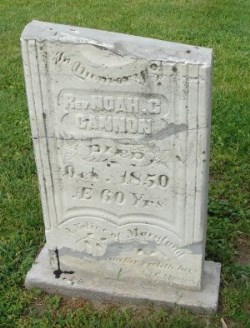
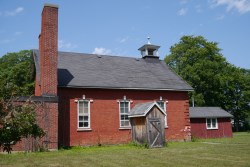
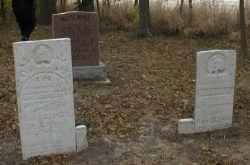
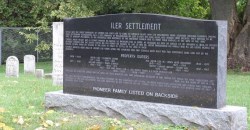
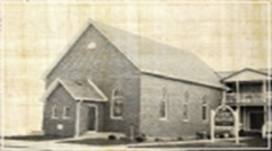
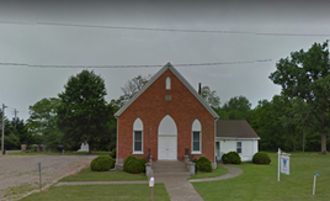
The area of the property that demonstrates cultural heritage value or interest is the area that includes the Central Grove Methodist Episcopal Church (a red brick Church built in 1910) and the Central Grove Cemetery which includes a large white monument.
Statement of Cultural Heritage Value or Interest
Historical/Associative Value
The property has historical value or associative value because it has direct associations with a theme, event, belief, person, activity, organization or institution that is significant to a community.
4005 County Road 11 retains significant historical and associative value because it has direct associations with people and an organization that is significant to both the community of Harrow and the Black community of Windsor and Essex County.
Built in 1910 with the frame of the original Grace Methodist Church in Essex to replace an earlier structure, the Central Grove African Methodist Episcopal (A.M.E)l Church has continued to be an important space for the development of religion and community within Harrow and the surrounding area.
The Central Grove A.M.E. church was originally founded in 1888 by local Black families after Reverand Joesph O’Benyon, a preacher from Sarnia, came to the area and hosted an evangelical campaign promoting the doctrines of the African Methodist Episcopal Church. The property was purchased in 1888 from Theodore Larabee for $200.00 by members of a small committee, namely James Johnson, Henry Graham, James W. Dennis, Squire Hamilton, and Peter Jackson. Originally, the congregation met outside until a small frame church was built at the end of 1888. The church was named Central Grove due to its location, being a central location for people from the communities of Pleasant Valley, Gilgal, and New Canaan.
In 1910, church trustees acquired the frame of the former Grace Methodist Church of Essex for $210.00, that was heavily damaged because of the 1907 Essex Rail Explosion. Members of the congregation and the surrounding Black settlements worked to construct a new facade, under the leadership of William Kersey and Ezra Davey.
Anthony Banks was one of the members of the congregation that helped construct the new church. He was very involved with the Colchester South community and the Central Grove A.M.E Church, as he was one of the founding members in 1888. He advocated for access to education and served as a schoolboard trustee. Banks was also the 1st Black constable of Essex County, appointed on April 12th, 1881, the Deputy Warden for the Ontario Game and Fishing Commission, a Bailiff, and Road Master. He is buried in the cemetery behind the church, along with his wife, Susan.
Delos R. Davis also helped construct the new church. He was the first Freedom Seeker to become a lawyer in Canada, and the first Black man to make the King's Counsel in the British Empire. Davis would have a large impact on the community of New Canaan and nearby Black communities, like Harrow and Gilgal, as he advocated for the education of children. Before becoming a lawyer, he taught at the Gilgal A.M.E school in the early 1870s, until he resigned and began pursuing his career in law. He began to study law under attorney Charles Robert Horne and would become a Notary for the Province of Ontario on June 19, 1873. Due to his race, he was unable to complete his education, as the Law Society of Ontario required that all students work with an established lawyer, before writing their examinations for The Bar. No lawyer in the area would hire him and he was unable to complete his education until 1886, after a special act authorizing the Supreme Court of Judicature for Ontario to admit him as a solicitor. This act was pushed by M.P.P William Douglas Balfour and on Nov. 15, 1886, Delos R. Davis was admitted to The Bar.
The property has historical value or associative value because it yields, or has the potential to yield, information that contributes to an understanding of a community or culture.
4005 County Road 11 retains significant historical and associative value because it has the potential to yield information about the communities of New Canaan, Pleasent Valley, and the Black community of Harrow. The church was connected to several historic Black communities within the surrounding area and served as a space for members of those communities to congregate and interact with each other. The church would aid in the greater development of the Black community and serves as a reminder of all of these settlements.
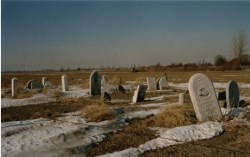
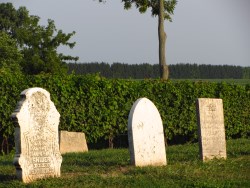
Alongside this, the property can provide information about prominent Black families connected to the church through the Central Grove Cemetery. It provides information on the family history of those families, their lifestyles, and the types of burials and headstones that were commonly used throughout the cemetery’s use.
Contextual Value
The property has contextual value because it is physically, functionally, visually or historically linked to its surroundings.
4005 County Road 11 retains contextual value because it is physically linked to its surroundings due to the Central Grove Cemetery. The Central Grove Cemetery is a historically Black cemetery that was established as early as the 1860s by African American freedom seekers who had come to Canada after fleeing slavery in the United States via the Underground railroad. The cemetery has connections to various prominent Black families and is still in use by the descendants of those original families.
The property has contextual value because it is a landmark
4005 County Road 11 retains contextual value because it serves as a landmark. It is a well-known marker within the community due to its longstanding history and connection to the Black community of Windsor and Essex County. It also serves as a waypoint within the Town of Essex, as it sits at the intersection of County Road 11 and the 4th Concession Road.
Description of Heritage Attributes
The key heritage attributes that contribute to the historical and associative value of 4005 County Road 11 includes:
- The mass, form, and style of the church,
- The red brick cladding on the exterior of the sanctuary,
- All existing window openings and wooden sills,
- Wooden molding above windows,
- Roof line and peak,
- Inset stone on the front façade,
- Fieldstone foundation,
- The wooden door and white molding above the door frame,
- All existing burials and headstones,
- The white monument in the middle of the cemetery.
The key heritage attributes that contribute to the contextual value of 4005 County Road 11 as being physically, functionally, visually and historically linked to its surroundings and as a landmark includes:
- The location of the Church and cemetery on lands at the northwest corner of County Road 11 and the 4th Concession Road, central to the communities of Pleasant Valley, Gilgal, New Canaan and Harrow.
- The location of the cemetery on the lands.